
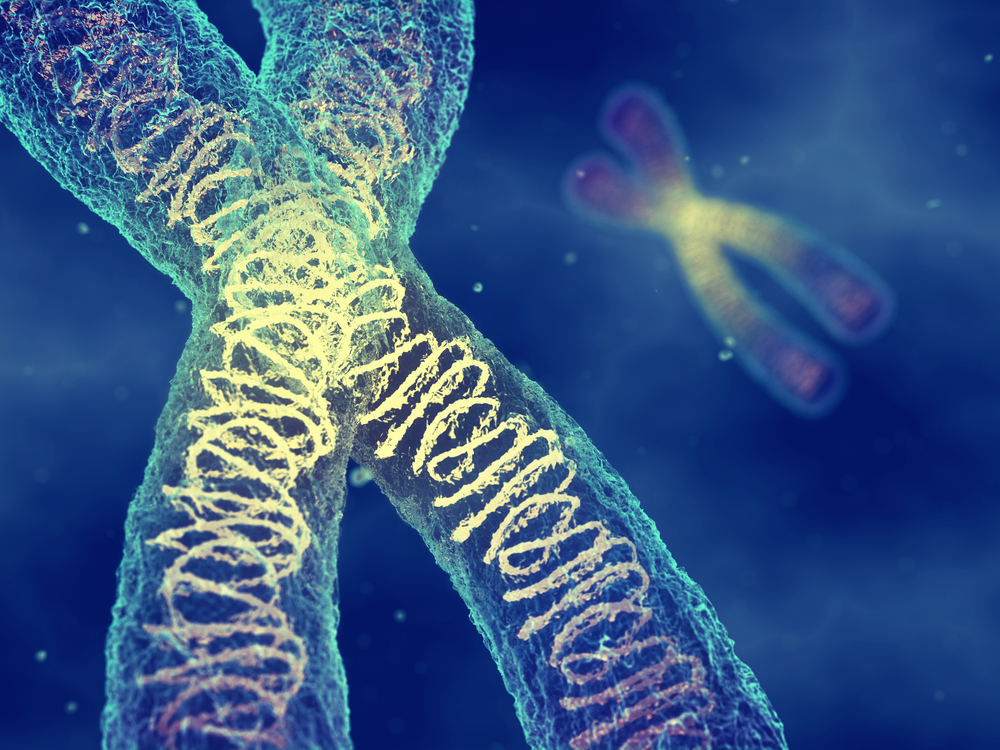
Our bodies are made up of trillions of cells. Almost every cell has a nucleus (a sac in the middle of the cell) containing a complete set of genetic material - your genes. Genes are the chemical instructions that tell the body how to make all the different parts it needs to function.
Our genes are made up of DNA. The information in DNA is stored as a code made up of four chemical building blocks - called bases. These have each been given a letter that represents the chemical they are made of. These are A (adenine), T (thymine), C (cytosine) and G (guanine).
This is called the genetic alphabet. DNA can be thought of as a long sentence written in a four-letter alphabet.
Genes vary in size from a few hundred DNA base pairs to more than two million base pairs. Genes come in pairs – one from each parent – meaning you have two copiers of most of your genes.
A gene sequence is written as a string of letters. The order matters because this is the code that cells read to make proteins that make the body function. The sequence of letters determines what message is sent and what protein gets made.

DNA sequencing can show the order of the chemical building blocks in genes. In whole genome and whole exome sequencing the building blocks that make up the DNA code are read and compared with a reference sequence.
This reference sequence is a standard set of DNA code that represents what is expected in most people.
The base pairs are examined to see if there are differences that could be the cause of the child’s health condition. These differences are known as variants.
Not all genetic variants lead to disease and each of us carries some. Most have no effect at all, while others only have mild effects. The few that do cause disease are called pathogenic variants.
Whole genome or whole exome sequencing tests (sometimes referred to as WGS or WES) are used to look for a genetic cause for health issues where other testing has not been able to find the cause. Mostly, this testing is used in newborns and children who have global developmental delay, intellectual disability or congenital anomalies –changes that are present from birth.
Some genes give instructions (codes) for making proteins. Proteins are the tiny molecules that do most of the work inside your body. When we say a gene "codes for" something, we mean it tells the cell how to make a specific protein.
Not all genes make proteins. The regions that give instructions for making proteins, call the coding regions, are about one to two percent of the entire human genome. Less is known about non-coding genes however we know that non-coding genes are important for controlling how other genes work.
Whole genome sequencing (WGS)
Whole genome sequencing is a test that reads all the building blocks of a person’s DNA to try to determine if there are variants in genes that could be responsible for their condition. It examines all of the genome, including the genes that do not code. It also examines mitochondrial DNA which is separate to the DNA in the cell’s nucleus. Variants to mitochondrial DNA can cause a wide range of health conditions.
Whole exome sequencing (WES)
Whole exome sequencing is a test that can be performed instead of whole genome sequencing. It looks only at the DNA sequences within genes that code for proteins and the remaining non-coding DNA sequences are not looked at. This test is done if the doctor thinks the cause of the condition will be found using whole exome sequencing as it is faster to perform than whole genome sequencing and does not cost as much.
Singleton analysis or trio studies
Usually, a trio studies approach is preferred for whole genome or exome analysis. This means the genomes of the child and each biological parent are analysed together.
This helps to show whether a gene variant has been inherited or whether it is de novo.
A de novo variant is when a gene mutation is a new genetic change that appears for the first time in a child, rather than being inherited from either parent. A de novo mutation usually happens in a parent’s egg or sperm cell or in the fertilised egg soon after conception.
An inherited gene variant is one that exists in one of the parents and was passed on to the child through that parent’s egg or sperm.
Trio analysis makes it more likely that the variant causing the health issue will be identified. This is done by using information about the parents’ genes to narrow down which gene variant might be causing the issue. If the same variant that is found in the child is found in the parent, but the child and parent do not have the same health issues, this makes it unlikely that the variant is causing the health issues in the child.
It is especially helpful in detecting the genetic causes of rare diseases. Trio testing also helps to determine the risk of the parents having a child with the same health issues in future.
Sometimes a singleton analysis is performed. This looks for variants in the child that are known to cause a disorder. It useful when there is no available family data or when the disorder being investigated is known to be not inherited.
Sample
Whole genome and whole exome sequencing tests are usually performed on a blood sample. Where it is difficult to obtain a blood sample, such as in children with severe autism or young babies, a cheek swab or saliva sample can be used. However, with these samples there is a higher chance of there not being enough DNA in the sample to do the testing, which is why blood is preferred. If a cheek swab is being used, it is important to avoid eating, drinking or smoking for at least 30 minutes before the sample is taken. Laboratories may have different preferences for the sample type, so it is best to check with your doctor before sample collection.
Any preparation?
None
Sometimes a variant is found in a gene that is known to cause the condition in the child, and these are called pathogenic or likely pathogenic variants. When there is plenty of evidence for the variant being the cause, it is called pathogenic. When a particular variant is likely to be the cause, but there is slightly less evidence it is called likely pathogenic. Finding such a variant will usually be enough for the child to be given a diagnosis and for the doctors to develop a treatment and management plan. Understanding the cause of the condition can provide important information on how other children in the family may be affected.Result What this means Benign changes Each letter in the genome is compared with the reference sequence to look for differences. For all of us there are many thousands of differences between our DNA sequence and the reference sequence. They mostly do not cause any problem and are termed benign changes or variants. Pathogenic variant and likely pathogenic variant Variants of uncertain significance (VUS) Sometimes gene variants are found, but their clinical significance is not known. They are called variants of uncertain significance (VUS). As our knowledge of these gene variants improves over time, it may be possible to reclassify them as benign or pathogenic. Even after looking at all the building blocks in all genes the cause of the child’s condition may not be found. Whole genome and whole exome sequencing tests work best for the diagnosis of monogenic conditions – problems caused by a pathogenic variant in just one gene. However, for some children there may be more than one gene involved, or the condition may not be genetic in origin; these tests cannot find the cause in these cases.
Generally speaking, a whole genome sequencing or whole exome sequencing test result can take as long as 6 – 9 months.
Whole genome or whole exome sequencing are covered by Medicare in certain circumstances.
In general, the test is covered for children born with physical differences, intellectual disabilities or global developmental delay, or facial features that suggest they have a genetic condition. A specialist doctor will make the decision.
The test can only be ordered by a clinical geneticist (doctor of genetics) or a specialist paediatrician (doctor for children), following consultation with a clinical geneticist. A simpler and less detailed typed of genetic test called a microarray test must have first been done and found to be “non-informative” - in other words, the issues the child is having were not explained by the results of the microarray. You can read more about microarray testing here.
The choice of tests your doctor makes will be based on your medical history and symptoms. It is important that you tell themeverything you think might help.
You play a central role in making sure your test results are accurate. Do everything you can to make sure the information you provide is correct and follow instructions closely.
Talk to your doctor about any medications you are taking. Find out if you need to fast or stop any particular foods or supplements. These may affect your results. Ask:
Pathology and diagnostic imaging reports can be added to your My Health Record. You and your healthcare provider can now access your results whenever and wherever needed.
Get further trustworthy health information and advice from healthdirect.